

Charcot Marie Tooth Disease
What is it? What can be done
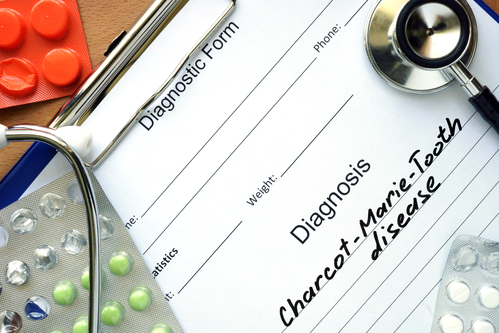 Charcot-Marie-Tooth disease at first always sounds like a problem with teeth. It is not however, it was named for three neurologists Charcot, Marie and Dr. Howard Tooth who first clinically described in in 1886.
It is apparently an inherited neurological disease, and is referred to as a hereditary neuropathy (nerve damage). It affects both motor and sensory nerves. It is referred to as Charcot-Marie Tooth syndrome, CMT, hereditary motor and sensory neuropathy HNSN, and Peroneal Muscular Atrophy, PMA.
There is also a condition named Charcot Foot. It is connected to neuropathy and is talked about on this page Neuropathy.
The periphery nerves – the ones affected – are located outside the main central nervous system. Periphery nerves control muscles, as well as relaying data from our arms and legs to our brain, which allow us to sense touch. Charcot-Marie-Tooth disease (CMT) involves muscle weakness and loss of sensation, predominantly in the arms and legs, especially in the calves.
This disease affects the periphery nerves, which control muscles and send messages from the legs and arms to the brain. These messages give us our sense of touch. The disorder generally makes itself known in childhood or adolescence, though this can happen at any age.
Symptoms of Charcot Marie Tooth Disease
The earliest indicators of CMT are usually clumsiness and weakness in the ankles, feet and legs. The feet may be either extremely arched or extremely flat, and the toes may be curled upwards, into “hammertoes”. Walking can be awkward due to the weak ankle muscles. It causes the individual to step higher than normal; the toes may drop forward.
As with any neuropathy, arms and feet become numb. Injuries can occur due to lack of sensation.
Symptoms are:
- Weakness in the muscles of the lower feet, legs and ankles
- Ankle becomes unstable because the feet are very highly arched, or less commonly, very flat.
- Hammertoes (curled toes)
- Lifting up of the foot is difficult because of weak ankle muscles (footdrop)
- A step (stride) which is higher than normal (an awkward step/gait)
- Numbness in the arms and feet
- Changing leg shape – the section of the leg below the knee becomes very thin, while the thighs retain their normal muscle volume and shape (stork legs) Cramping can occur in the lower legs and forearms, and some of the body’s reflexes can deteriorate. The hands suffer weakness and atrophy in the muscles and fine motor ability decreases.
Balance is affected due to the motor nerves being damaged. The spine may curve, scoliosis. There may be some hearing or sight loss depending on the nerves affected.
Symptoms may vary. Some people will have mild symptoms that do not interfere with their ability to live normal lives. Very often though, numbness and weakness will have far-reaching effects.
CMT does not affect life expectancy. As with any nerve damage, there can be progressive muscle weakness and other neuropathy symptoms.
Progressive signs and symptoms may include:
- The patient’s hands and arms become more affected.
- Problems with manual dexterity, such as doing up buttons, or opening jars and bottle tops.
- Muscle and joint pain resulting from problems with walking and posture which place a strain on the body.
- Neuropathic pain cause by damaged nerves (less common).
- General walking and mobility problems, especially with older patients.
Causes
There are two parts of the nerves”
- The axon – the inside of the nerve. Like the metal part of an electric cable. The electrical information between the brain and the limbs passes through the axon, in the same way electricity passes through the metal part of a cable (wire).
- The myelin sheath – the insulation around the axon, in the same way a wire/cable may have some kind of plastic insulation around it. The myelin sheath wraps around the axon, protecting it, as well as helping restore the quality of the electrical signal.
Either the axon or myelin sheath, or both, may be affected when a patient has CMT – it depends on the type. Mutated (faulty) genes cause the disintegration of the myelin sheath. If the myelin sheath wastes away it becomes thinner and thinner, eventually the axon becomes damaged and the patient’s muscles no longer receive clear messages from the brain, resulting in muscle weakness and loss of sensation (numbness).
In some types of CMT the axons are directly targeted, also as a result of faulty genes. For some reason the electrical signals are not transmitted at the required strength to activate muscles and senses, resulting in weaker muscles and poorer tactile sensitivity (numbness)
Treatments
Treatments are available that can make a difference in quality of life.
1) Physical therapy can stretch and strengthen the weak muscles.
2) Occupational therapy will help.
3) Orthopedic devices, like braces or splints, or special shoes or inserts, can help the individual to walk more easily.
4) Thumb splints can cause a return of some dexterity. A back brace may be in order for those with scoliosis.
Treatment for Neuropathy
There are many medications, and other remedies that can bring you relief, you can read about them in this article Neuropathy Treatment
What can you do:
Lasting Relief*
None of the various neuropathy treatments will build healthy nerves. You can cover up the symptoms and you can increase circulation and you can make a person feel less pain, etc., but if you build healthy nerves, there will not be any symptoms (healthy nerves don’t hurt, tingle, burn, are not numb, etc.) and the relief will be lasting.
Building Healthy Nerves
Healthy sensory nerves mean that they are not painful. Healthy nerves means that they communicate and don’t send wrong signals such as burning, hot and cold, tingling when there is no reason for it. Healthy motor nerves mean that they relay messages from the brain to the muscle so that they move correctly. Nerves need to be healthy to function properly.
The body needs specific nutrients (vitamins) to be able to build healthy nerves.
It may not give immediate relief (although many do feel changes in the first week) as the vitamins are working at a cellular level, but it does address the actual problem, builds healthy nerves and brings lasting relief.
(For temporary relief while building healthy nerves, go to Pain Relief Formula)
What can be done for lasting relief?
Find out how to Build Healthy Nerves
Sign up to receive the MCVitamins Newsletter!
Up-to-date info on the latest health-related news happening in the world
(available in English only)