|
Visit
our Health Index for More Subjects, Conditions and
Answers
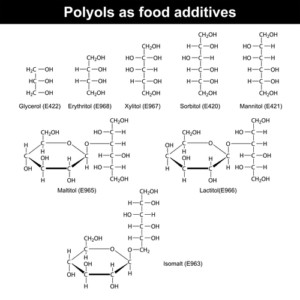
Maltitol
(Per the Wikipedia)
Maltitol is a sugar
alcohol (polyol) used as a sugar substitute. It
has 90% the sweetness of sugar and nearly identical
properties, except for browning. It is used to very
easily replace sugar and has less food energy, does not promote tooth decay and has a
somewhat lower blood sugar response. Unfortunately,
maltitol is well known to cause gastric distress,
particularly if consumed in great quantities.
Chemically, maltitol is also known as 4-O-α-Glucopyranosyl-D-sorbitol.
Commercially, it is known under trade names such as Maltisorb
and Maltisweet.
Production and uses
Commercially, maltitol is produced by Cerestar,
Roquette, SPI Polyols, Inc., and Towa Chemical
Industry Co., Ltd among other companies. Maltitol is
made by hydrogenation
of maltose
obtained from starch.
Its high sweetness allows it to be used without being
mixed with other sweeteners, and exhibits negligible
cooling effect (negative heat
of solution) in comparison with other sugar
alcohols, and is very similar to the subtle cooling
effect of sucrose.
It is used especially in production of sweets -
sugarless hard
candies, chewing
gum, chocolates,
baked goods, and ice
cream.
Metabolism of maltitol
Maltitol, like other sugar alcohols, does not brown
or caramelize.
It is not metabolized by oral bacteria, so it does not
promote tooth
decay. It is somewhat more slowly absorbed than
sugar (sucrose) which makes it somewhat more suitable
for people with diabetes
than white sugar (sucrose).
It is very important to be aware that its blood sugar
impact is far from negligible and some traditional
sugars, such as fructose, actually have a
significantly lower impact on blood sugar
Its food
energy value is 2.1 calories per gram (8.8 kJ/g);
(sugar is 4.0 cal/g (16.7 kJ/g).
Due to its slow absorption, excessive consumption
can have laxative
effect and often can cause gas and/or bloating.
Maltitol is particularly demonized regarding gastric
side effects because it is so easy for food producers
to use it in vast quantities (due to its amazingly
sugar-like properties) so consumers often end up
consuming far more than they could most other sugar
alcohols. While this is a major problem with maltitol,
many sugar alcohols are far more likely to cause
gastric distress than maltitol when compared
gram-for-gram.
The Atkins Diet Center has done research that indicates
sweeteners that contain aspartame (such as NutraSweet and
Equal) stimulate insulin production (leading to unstable blood
sugar, irritability and carbohydrate cravings). Sweeteners
that use sucralose (marketed as Splenda) and saccharin (such
as Sweet'nLow) have not been shown to stimulate insulin
production.
See Maltitol
See Aspartame
See High Fructose
Corn Syrup
See Saccharin
See Evaporated
Cane Juice
See Splenda
Try the
all natural Pain
Relief
Formula,
not a
drug, and it works!
We
take privacy and security seriously, read about
it here
Home
Health
Tips Health Concerns
Site Index
Glossary
We have used our best judgment in compiling this information. The Food and Drug Administration may not have evaluated the information presented. Any reference to a specific product is for your information only and is not intended to diagnose, treat, cure, or prevent any disease
|